Introducing Selina: How can we understand smallholder risk attitudes?
In this blog post, we met with new NISD member and UEA DEV visiting researcher Dr Selina Bruns to ask what brought her to Norwich and what she will be researching.
Can you tell us a little about your background?
I grew up in Germany and become interested in economics from a young age. While I was at school my brother told me about the microcredit work of Muhammad Yunus and I was immediately inspired by how a business tool could be used in a creative way to help people in extreme poverty. From that moment I decided that I wanted to study business, to understand what it is and how it can work to help people.
During my undergraduate degree, I realised that most people study business to get jobs in banks and that I wanted something different. I wanted to learn about business so that I could apply it to help people living in poverty. But this direction brought another question that I wanted to work out: who are people live in poverty?
The largest group that live in poverty tend to be smallholder farmers, involved in agriculture and predominantly based in the Global South. To understand more about these groups, I began a masters in sustainable international agriculture to work out what the life of a smallholders looks like from a business perspective – how do they make choices? How do they approach risk?
My masters allowed me to build on my business background, to get a better idea of these questions form an agricultural perspective. This lead me to my PhD at University of Göttingen where I studied the sustainable economic growth of Cambodian smallholders. During that work I was trying to understand why some people are in poverty and some are not.
It was during my masters that I first came across Arjan Verschoor’s work looking at risk and insurance. Since then, I pretty much read everything Arjan published. After my PhD, I wrote to him to ask if we could work together, and that’s how I ended up in Norwich.
What are your research interests now?
I am still interested in the sustainable economic growth of smallholder farmers. I think that will always be the core of my research.
More specifically though, I’m interested in behavioural factors that explain the difference in performance between individuals and groups. Risk attitudes are one behavioural factor that I like to focus on because it’s so important.
When we conceptualise behavioural risk, this leads to two other thoughts. The first is “how do we know the risk attitude of someone?” It’s a difficult questions and I’m interested in methodologies that can be used to answer it.
The other dimension is that measuring risk attitudes is difficult. Often these measurements take place amongst challenging infrastructure, low literacy and other factors that externally influence attitude measurements.
There is suggestion that an individual’s mental capacity is taxed just by living in poverty and focusing on the challenges that brings. This mental taxation is important for informing the design of risk attitude experiments but it also affects real work choices individuals make.
Only when we understand the behavioural components can we introduce other economical interventions to improve welfare.
Through trying to understand methods to measure risk attitudes, I stumbled across this problem of taxed cognitive capacity and it sparked my interest. How does it influence training or new opportunities for an individual if they are thinking about their problems, or mentally fatigued through dwelling on those other thoughts. It’s hard to pay attention when you have other pressing issues in life. The individual might not be able to focus or realise the potential of a new opportunity.
So how can we make sure that when we speak to individuals in these contexts, that we share the importance of these things in an effective way.
We need too think about these aspects when we think about measuring risk attitudes. If we have someone with only limited attention, how do we grab what share might be there, so that we can get a glimpse of their nature, with less noise in the data?
Another challenge is that many risk tests are extremely complex. They are hard to understand and subsequently, they are difficult to get meaningful answers from. What we need is to try and develop experiments that are easy to grasp but ones that give us consistent insights into risk behaviours.
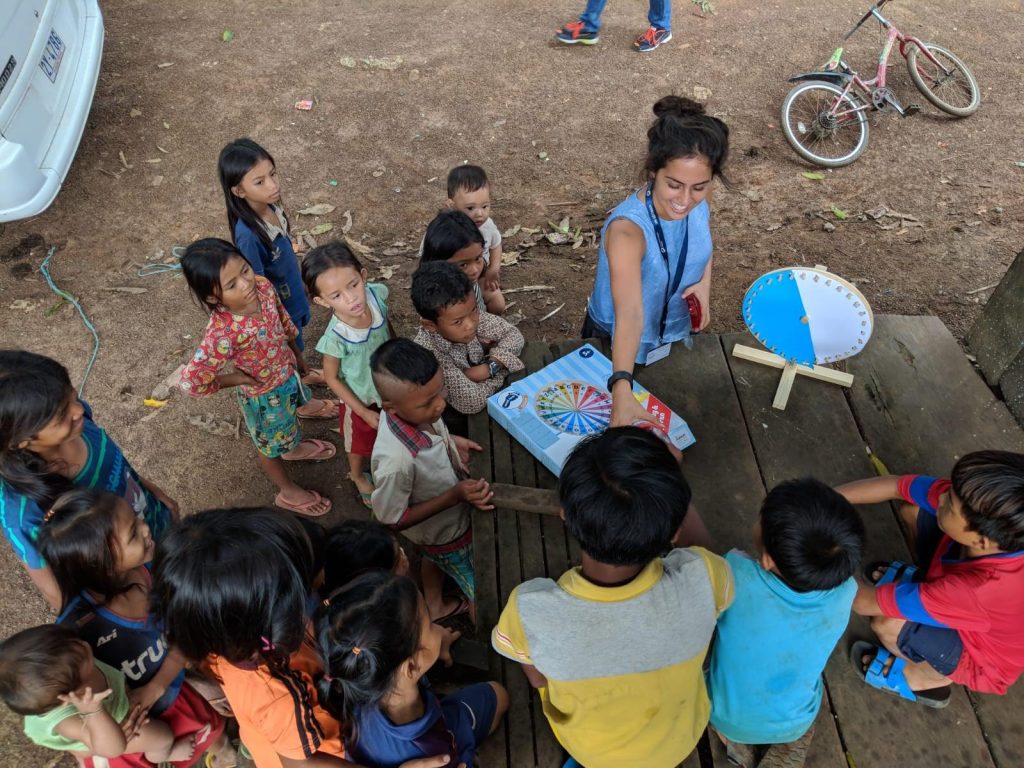
Recently, I’ve been using a wheel as an approach. At its core, we demonstrate simple probabilities as a pie chart. This pie chart is put on a spinning wheel and we demonstrate the chance of winning a certain amount of money by spinning the wheel.
The participant then has to decide if she wants to spin the wheel (i.e. play a risky game) or if she prefers a safe amount. By repeating the game over several rounds – whereas altering the riskiness of the wheel – we can estimate the participants risk attitude. The game appears to be easy to understand and engaging for all ages.
Why is this kind of research important?
It is important on different levels. If we look from the sustainability perspective, it’s important to understand behavioural traits, like risk attitudes. Only when we can understand these behavioural components can we introduce the other economical interventions that can improve welfare.
To take an analogy, we can think of financial resources of salaried individuals routinely going up and down e.g. at the start and end of month. When we speak to people in this kind of employment, we know this time dimension affects the context of our respondents and so it informs our questions.
Cognitive capacity is the same. When we’re tired, we can’t concentrate properly. When we are in a tired headspace, amazing programmes might come our way but we might not recognise it for the potential it has.
We see these kinds of results in the field through puzzling data. For instance, we might have one particular group who won’t participate technologies that have been useful for other groups just like them. In this case, there could be this cognitive component that is making a difference as.
We need to understand this cognitive component so that we can better inform systems to reach every group in a community.
You’ve just started working with UEA and the NISD. What are you working on in the next few months?
The main thing I am working on at the moment is how to measure risk attitudes and I will be testing this in the field.
Arjan has a great deal of experience in measuring risk attitudes so it’s great to be able to collaborate. The objective at the moment is to design an experimental method to elicit risk attitudes. We’re hoping to combine the theoretical background of Arjan’s work with my illustrative approach.
The most important thing is designing something that makes sense to the people we meet. We have a concept in development and plan to be at the Field Lab in Uganda in February to test it to check if people understand it. Ultimately we will then compare it to other methods of measuring risk management and see if it has less noise in the data. If promising, maybe by mid-2023, we want to do a full study with it.
How have you found your time in Norwich so far?
Norwich is a really nice city. I find it very easy to get along and it’s safe and the campus is nice. Everyone is super friendly.
There are a few things that stick with me about the university. What I have found wonderful is that there is a very vivid community working on experiments from different disciplinary angles. It means that I see behavioural choice projects that are not just economists but also include other groups like anthropologists and natural scientists – which each group learning from the additional angles. If you are an experimental researcher, this is the place to go.
The NISD itself is special because it has this transdisciplinary approach where researchers come together for the betterment of the problem. I think that is important and I’m enjoying being a part of it.

Dr Selina Bruns
Share this article