Introducing Janet: what enables farmer adoption of improved sweet potato?
Janet is a new PhD student of the NISD. In this blog post, we met with Janet to ask what brought her to UEA and what she will be researching during her work on adoption of improved sweet potato varieties.
Can you tell us a little about your background?
My name is Janet Mwende. I’m originally from Machakos in Kenya and live there up to high school. I have a background in agricultural and applied economics. I completed my master’s thesis at the International Potato Centre (CIP) on the willingness of caregivers of children under the age of five to incorporate orange-fleshed sweet potato into infant and young child feeding.
After my masters, I joined the National Treasury in 2019 as an intern under the African Economic Research Consortium/Government of Kenya capacity building program with posting to the Public Investment Management unit. The unit was established in 2018 as part of public finance reform initiatives among other roles to appraise projects before they are pipelined for budgeting. My work was to review proposed projects concept notes and feasibility studies reports, checking that they demonstrate a case for investment in line with government priorities and development plans.
What are your research interests now?
My PhD research will focus on the role of behavioural interventions in the adoption of improved sweet potato varieties in Kenya and Uganda. Several improved sweet potato varieties, such as the orange-fleshed sweet potato, that are high-yielding, nutritious, disease and pest tolerant, and climate-resilient, have been promoted over the last ten years. Despite the benefits these varieties provide, smallholder adoption remains low.
Can you tell us a bit more about the PhD?
My supervisors are Maren Duvendack and Arjan Verschoor of the School of International Development at the University of East Anglia. We are partnering with CIP. During the PhD, I’ll be looking at field sites across Kenya and Uganda.
In Kenya, the adoption of these sweet potatoes is particularly low so I want to see why this is the case. I will follow the knowledge exchange and adoption process to see what is happening. I’m particularly interested in the seed distribution of these varieties and where the missing link might be.
In Uganda, I will assess the problems farmers face in obtaining improved sweet potato planting materials, as well as what behavioural interventions can be implemented to increase demand for the seed of these varieties.
Why does work like this matter?
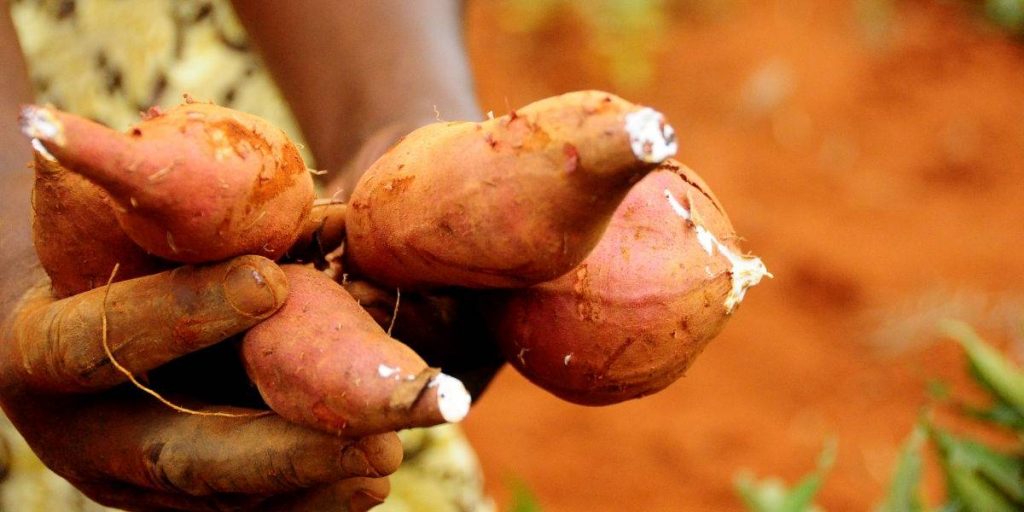
Improved sweet potato varieties can benefit farmers in areas where sweet potato virus diseases, pests and undernutrition are common. Some of the varieties have been shown to contribute to vitamin A deficiency while also providing farmers with higher profits than traditional varieties. The orange-fleshed sweet potato, for example, is a good product. It is nutritive, fast-maturing, and drought tolerant. Besides that, sweet potato is profitable and can be processed into a variety of marketable products.
Improved sweet potato varieties provide an option that should be suitable and appealing to a wide range of farmers. Nonetheless, farmers are not using them. Despite investments in research and promotion, farmers are not reaping the benefits of these varieties. We need to understand why we aren’t able to reach farmers with improved sweet potato planting materials and what interventions, based on demand, can be implemented to improve adoption.
How do you hope this project will make a difference?
I hope to contribute to understanding how behavioural interventions can be designed not only to increase farmer demand for improved sweet potato varieties but also to have a ripple effect on the supply side, where changes are also required to have a self-sustaining seed distribution system.
Share this article