Information and Quality Seed Dissemination Nudges to Boost Delivery by Model Farmers
Janet Mutiso, NISD PhD student.
In many developing countries, model farmers are being enlisted to complement and bridge the limited reach of formal extension agents in disseminating information and agricultural innovations to co-villagers. However, the approach continues to face difficulties that render it less effective. First, the approach fails to draw from multiple knowledge sources to account for the multilayered dynamics of information diffusion. Second, some model farmers fail to share information. Third, evidence suggests that male model farmers tend to apply lower effort than their female counterparts in extension activities. The last point is especially important given the partriachic nature of rural farm communities in which male heads of the household make farm and non-farm decisions. The question thus would be how to get male model farmers equally motivated to share new information and innovations.
Two mechanisms directed at motivating model farmers to be more active in disseminating information have been empirically tested, namely, financial and non-financial incentives. As to the former, financial rewards to model farmers for outreach effort have come under scrutinty and been subjected to criticisms on the basis of sustainability given implications for the national budget. More focus has therefore been directed to non-financial incentives. One non-financial incentive currently being tested using a large-scale field experiment in Uganda is the use of so-called ‘nudges’. Instead of offering direct monetary or other incentives, nudges can leverage psychological biases in decision-making and perception to encourage specific decisions. For example, one may frame a decision by emphasizing the potential benefits of a particular choice, or, alternatively, by emphasizing what one must give up in taking that choice.

Figure 1: Nudges from a dyadic perspective
The field experiment in Uganda was set up in 2022, as a colloboratuve effort of the International Potato Center (CIP), the Norwich Institute for Sustainable Development (NISD), Cornell University, and the local government. Its aim was to assess the ways nudges can be applied in promoting the utilization of quality seeds. The study used a randomised control trial implemented in 120 villages, with posters, displayed in treatment villages only, serving as informational nudges. Using principles of comparative advertising, the posters portrayed the benefits of quality seeds over recycled, disease-infested ones. The intervention spanned two seasons and involved 1200 households (i.e., 12 farmers per study village) and 120 farmer model farmers (i.e., 1 model farmer per study village). Model farmers were trained to facilitate the sales of quality declared sweetpotato seeds. Both qualitative and quantitative methods were used to assess how nudges influence model farmers’ information and seed dissemination activities.
Results of the qualitative study indicate that farmers found the posters to be educative and suitable for conveying agricultural information. Posters stimulate interest with about 40% of farmers in the treatment villages seeking information about specific varieties compared to 31% in the control villages. Preliminary findings further suggest that peer farmers reading posters increases the likelihood of the model farmer giving them information about quality seed at the point of sale by 25%. According to the model farmers, the posters facilitate sessions where the peer farmers engage in discussions, seek clarifications, and make purchases. Further, a peer farmer reading the poster increases the probability they will purchase quality seeds from the model farmer by 19%. Model farmers report posters to ease their work, saving them time because farmers read, interpret pictures and make decisions on whether to try the seeds or not. The qualitative assessment shows that the nudges enhance the reputation and credibility of the quality seed source.
Displaying posters augment the efforts of male model farmers in sharing information, which is associated with a 14% increase in the probability of quality seed purchase. Word of mouth publicity by model farmers has no effect on the probability of seed purchase by the peer farmers. However, the model farmer providing the peer farmer with information at the point of sale increases the likelihood of purchasing quality seeds by 15%.
The preliminary results from two seasons of applying nudges are promising: they increase the reach and support the learning process. Posters are cheap and help strengthen information and quality seed dissemination by model farmers. However, model farmers reported challenges when crops did not perform as shown in the posters. To fix this issue, interventions should ensure that proper agronomy information on the utilisation of quality seeds reaches farmers. A simple agronomy pack can accompany the dissemination of quality seeds to clarify to farmers parameters such as planting spaces, moulding, and weeding that are needed to maximise their crop. Proper agronomic practices can help reduce the gap between what they see in nudges and what they experience when they experiment with quality seeds. Previous experiences show that farmers’ expectations of quality seeds are inflated and there is a tendency for perverse behaviour because of the assumption that complementary practices are not needed.
Acknowledgement: The study was undertaken with funding support from the Bill and Melinda Gates Foundation project on Root, Tubers and Bananas (RTB) Breeding, CGIAR Initiative on Market Intelligence and Program for Seed Systems Innovation in Africa (PROSSIVA). It was implemented as a collaborative research by International Potato Center, Cornell University, Norwich Institute for Sustainable Development and Uganda’s Ministry of Agriculture, Animal Husbandry and Fisheries (MAAIF).
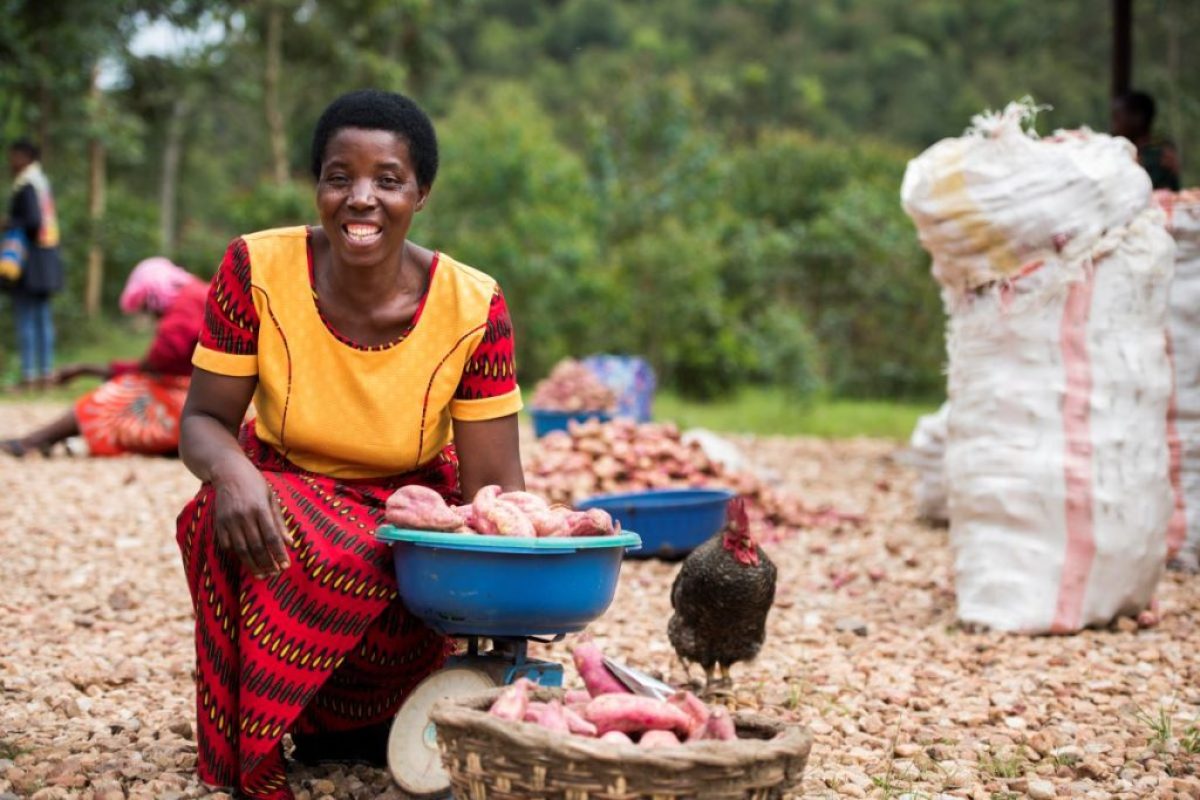
Featured Image: International Potato Center Sub Saharan Africa
Share this article