Scaling British Pulses: Moving From Field Trials to Market Reality
What if some of the crops that could help make British farming more sustainable are already available to us, but the systems needed to grow, process and sell them are not yet in place?
Peas, beans, chickpeas and lentils are attracting renewed interest as the UK looks for ways to make agriculture more resilient while reducing its environmental impact. Defra’s Farming Roadmap 2050, published in June 2026, explicitly frames the future of English farming around four core pillars: profitability, productivity, sustainability, and resilience. Grain legumes sit directly at the intersection of this vision. From my perspective looking at agricultural value chains, these crops are remarkable: they diversify crop rotations, contribute to soil health, fix atmospheric nitrogen and provide vital, low-carbon sources of protein for both food and animal feed.
Before the widespread use of artificial fertiliser, pulses were an essential part of arable rotations, replenishing soils between other crops. Their importance declined as synthetic nitrogen provided a rapid, predictable boost, enabling farmers to grow more lucrative crops continuously.
Today, however, extreme heat, spring droughts, and unseasonal flooding pose an urgent threat to the agricultural heartlands of East Anglia, resulting in major yield fluctuations and lost revenue. While legumes have enormous potential to cushion these climate vulnerabilities, their production remains limited. In 2025, around 60,000 hectares of combining peas and 141,000 hectares of field beans were harvested nationally. Compared with more than three million hectares of cereals, grain legumes occupy less than four per cent of total UK cropland, remaining a small and volatile fraction of overall grain production.
The challenge is not simply whether pulses can be grown. Our recent research in Norfolk suggests that their future depends on a bigger, socio-economic question: Can the food system around pulses support farmers to grow them profitably and reliably?
A crop may perform well in a field trial but still struggle to become part of mainstream agriculture. Farming decisions are shaped not only by agronomy, but also by markets, infrastructure, risk and the complex relationships connecting farms to the wider value chain.
From promising crop to economically viable crop
Our research, undertaken through the NISD, examines the real-world factors influencing whether farmers can grow more grain legumes.
Norfolk provides a critical setting for exploring these questions. As one of England’s major, highly productive arable farming regions, it has established, deeply entrenched markets for traditional crops like wheat, barley, potatoes and oilseed rape. A new crop cannot exist in a vacuum; it has to fit into this pre-existing farming system while providing a clear economic and environmental benefit.
To map these realities, we visited farms, spoke with processors, campaigners and researchers, and engaged with the community at major farming events including Groundswell and the Royal Norfolk Show. One of our key findings is the absolute necessity of distinguishing between agronomic potential and commercial viability.
Climate change may alter suitability profiles for parts of the UK, and field trials can demonstrate promising yields. But farmers fundamentally need crops that can be grown reliably, managed effectively, harvested efficiently and sold at a price that makes the inherent risks worthwhile.
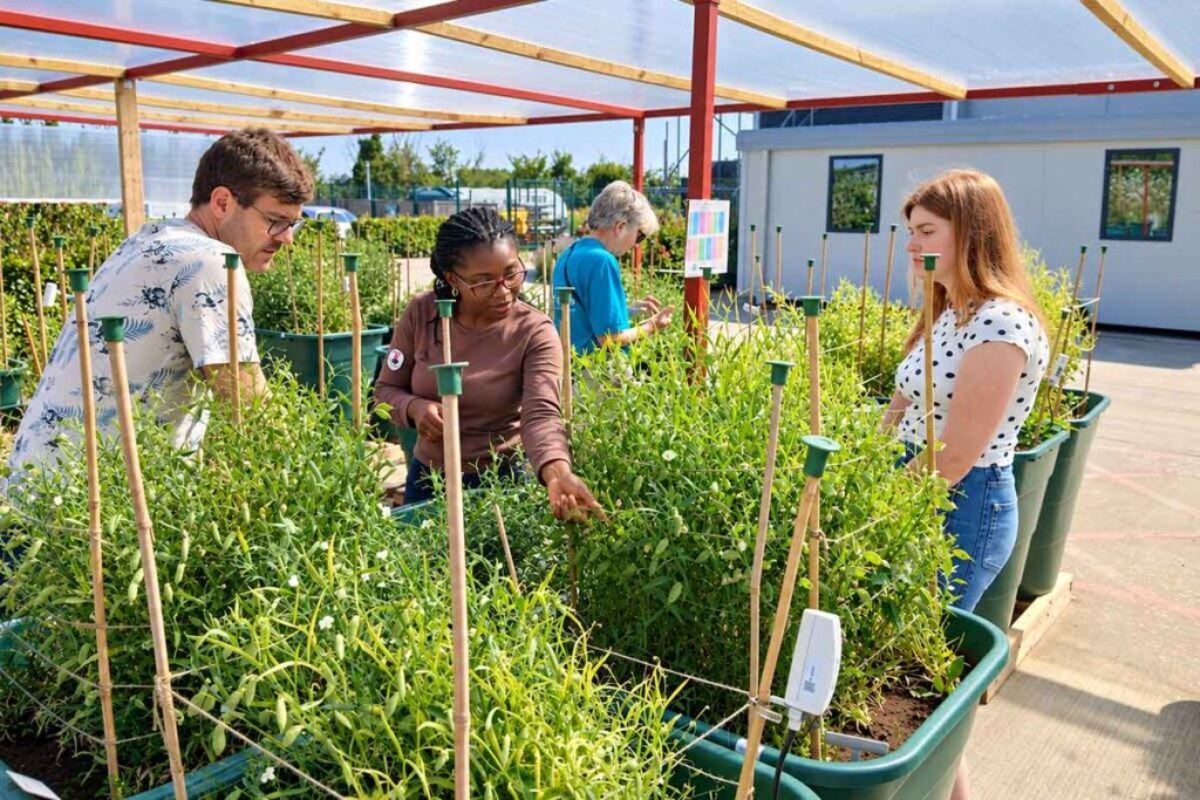
A commercial chickpea trial undertaken this year in Norfolk during unprecedented heatwaves perfectly illustrates the friction between field performance and market reality. The standing crop appeared to perform exceptionally well under extreme heat, with an estimated yield of 3.5 tonnes per hectare. Yet once uneven maturity, pod splitting, precise harvest timing and combining losses were factored in, the actual harvested output was considerably lower. While it remained potentially viable given the poor performance of other crops under these harsh conditions, it highlighted a vital truth: reliable, saleable output, rather than maximum theoretical yield, is what matters. Seed size, colour and maturity determine whether a crop meets buyer specifications and retains its value.
Farmers also need better evidence on the value of legumes across the whole rotation, including potential input savings and effects on following crops. As demonstrated at the Big Debate at the Royal Norfolk show this year, farming businesses are increasingly looking to calculate total rotation profits rather than single-crop yields. Future research must quantify these systemic, long-term agronomic and financial outcomes.
The market has to lead production
Consumer interest in healthier, plant-based diets does not automatically create a viable market for British farmers. For dietary change to transform agriculture, demand must travel reliably all the way back through the food system to the farm. Farmers need clear parameters on buyers, volumes, quality, and price before putting seed in the ground.
Different crops require completely different market pathways:
- Established Legumes (Peas and Faba Beans): Value-chain relationships already exist. Here, predictable commercial offtake can immediately coordinate the sector, giving growers planting confidence and giving processors the throughput needed to justify investment.
- Novel Crops (Chickpeas and Lentils): These cannot be scaled on consumer interest alone. They require multi-season development of varieties, seed supply, crop protection, and harvesting capability. Market development therefore must happen alongside agronomic development.
Crucial momentum is building to bridge these gaps. The Food Foundation’s 2026 work to increase uptake of pulses, and its ‘Bang in Some Beans’ initiative, have secured major procurement commitments from UK retailers, manufacturers, and food service operators.
Concurrently, new UK school food standards published in September 2026 give pulses a far more explicit role, requiring schools in England to serve a portion of beans, lentils, or chickpeas at least once a week. This may influence an increase in market demand.
However, policy guidelines alone will not create a functioning supply chain. Public procurement can only act as an anchor market if public institutions are deliberately connected to domestic growers. To turn this opening into dependable demand, school and hospital caterers will need active support bridging practical bottlenecks, including tight budgets, kitchen capabilities, recipe development, and supplier coordination.
Infrastructure is part of the puzzle, but has to be tailored to work well
Processing provides another example of why the wider food system matters. Does Britain lack the infrastructure needed to develop a larger pulse sector? Many refer to the ‘missing middle‘ between production and consumption – the parts of the food value chain routinely overlooked including cleaning, processing, transport and marketing. Our research suggests a more nuanced picture.
Norfolk already has capability for activities such as cleaning, grading and handling established pulses. Gaps become more apparent for particular crops, smaller batches and functions such as milling, canning, mixed-crop separation, extrusion and protein fractionation.
The question is therefore not simply whether infrastructure exists, but whether the right infrastructure exists for a particular crop, volume, specification and market.
This creates an investment challenge. Processors need sufficient volumes and reliable demand, while farmers need confidence that suitable markets and processing facilities will exist before committing land to unfamiliar crops. The result can be a cycle of waiting: farmers wait for buyers, processors wait for volumes and buyers wait for reliable supply. Breaking this cycle requires coordination across the value chain.
What role can policy and research play?
Policy can help, but interventions need to be carefully designed. Environmental payments from the Sustainable Farm Incentive could be modified to support edible as well as non-edible legumes allowing them to be sold commercially. On-farm trials can help farmers build knowledge and reduce the costs of experimentation; processors and potential retailers need similar supported opportunities to start new initiatives.
Procurement and contracts could provide greater certainty around demand, while targeted investment could address specific processing constraints. Procurement standards require a tailored, functioning supply chain with explicit goals to support the UK legume industry. Caterers may also need support with budgets, menu development, kitchen capability and supplier coordination.
Research has an equally important role. Organisations including the Processors and Growers’ Research Organisation, the Pulse Crop Genetic Improvement Network and the Novel and Underutilised Crops Network are contributing to knowledge around crops, food processing opportunities, bringing different parts of the food system together.
What can Britain learn from elsewhere?
The Norfolk research also raises a wider question: what can we learn from other farming systems? The Netherlands has not solved the challenge of increasing pulse production, but its universities have significant experience examining protein crops across the food system, from breeding and cultivation to processing, consumer behaviour and markets.
The EU Protein Action Plan, agreed in July 2026, also deserves scrutiny for policy opportunities that may be applicable to the UK. The next stage of our research will explore these lessons through a Dutch case study.
A systems question, not simply a crop question
Pulses are not a silver bullet for the challenges facing British agriculture. Farmers are dealing with changing weather, input costs, environmental requirements and uncertain markets. At the same time, there is growing interest in strengthening domestic food supply chains and increasing access to sustainable sources of protein.
Pulses could contribute to several of these objectives. But their potential will depend on whether they can be integrated into farming systems that are both profitable and resilient.
Madalitso Mgunda is a postgraduate student at the School of Global Development, UEA, the 2026 RNAA/NISD Norfolk International Scholar and Chevening alumni. She produced a master’s dissertation on this topic and is researching sustainable legume futures as part of a wider NISD project led by Professor Arjan Verschoor and Dr Natasha Grist.
Madalitso is grateful for the support of the Royal Norfolk Agricultural Association and NISD throughout this work, and for the financial scholarship support provided by the J.C. Mann Charitable Trust. For further discussion, contact Madalitso @ mada.mgunda@gmail.com.
Further reading about this project:
Radio 4 Farming today 23 September 2026 (available until 23 October 2026): https://www.bbc.co.uk/programmes/m0031t4q
UEA article July 2026: https://www.uea.ac.uk/about/news/article/how-beans-and-lentils-could-help-futureproof-uk-farming
Eastern Daily Press July 2026: https://www.edp24.co.uk/news/26262296.uea-student-malawi-aims-help-future-proof-norfolk-farms/
References:
• Defra – Farming Roadmap 2050: Growing England’s Future
• Defra – Sustainable Farming Incentive 2026: CNUM3 Legume fallow
• Department for Education – School food standards, September 2026
• The Food Foundation – Unlocking Commercial Growth for Beans (2026)
• The Food Foundation – Keen Bean Pledgers
• Pulse Crop Genetic Improvement Network (PCGIN)
• NIAB – Novel and Underutilised Crop Network (NUCNet)
Author

Madalitso Mgunda
Share this article
Follow us