Reflections from the Oxford Farming Conference: innovation, community and resilience
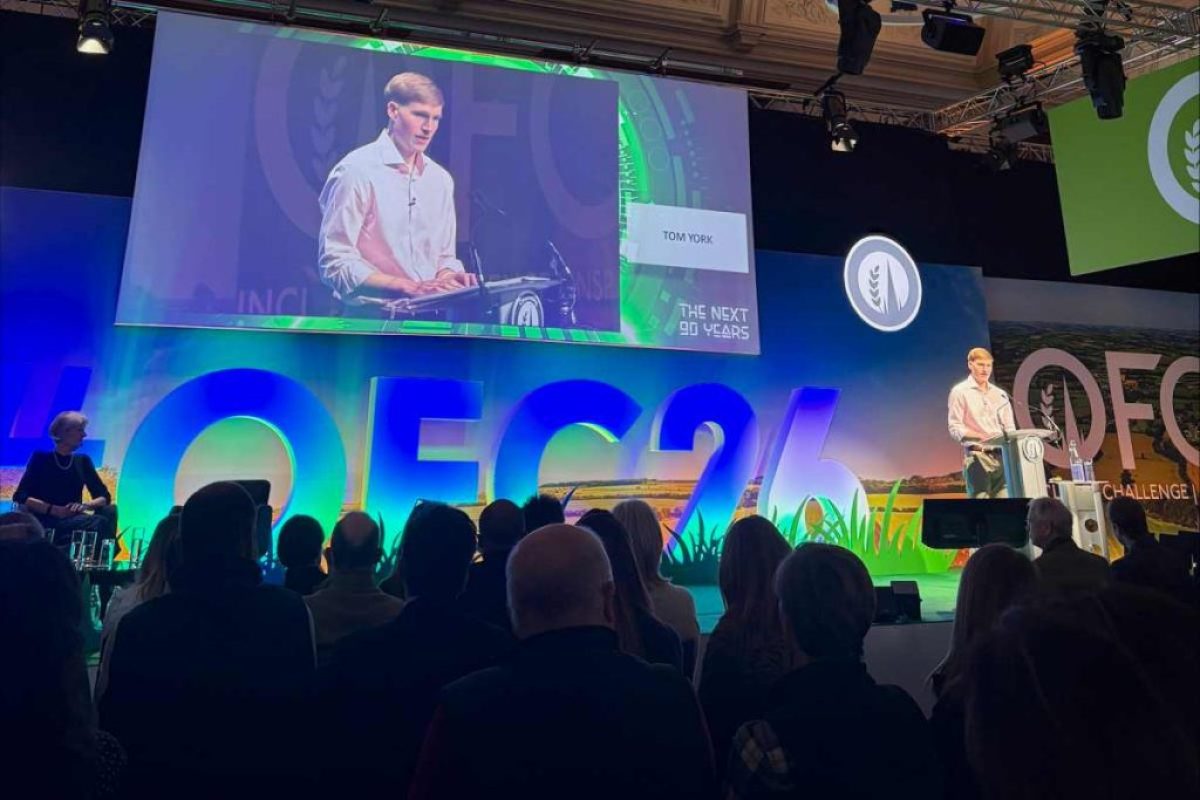
This January, I attended the Oxford Farming Conference for the first time as an Oxford Farming Conference Scholar. As an early career researcher, the conference offered a valuable opportunity to step outside of my ‘research box’ and engage directly with the ideas, people and debates shaping the future of farming and food systems.
Growing Resilience – economic, environmental and social – was the theme throughout this year’s conference. Across policy discussions, innovation showcases and personal reflections, there was a clear recognition that farming faces growing uncertainty, and that responses must be flexible, inclusive and grounded in real-world experience.
One of the highlights for me was the Inspiring Innovators session, which showcased practical solutions to some of the most pressing challenges facing the sector. From Tom McVeigh’s work exploring walnuts and hazelnuts as climate-resilient UK crops, to Isaac Oor’s PneuMonitor technology improving livestock health through better control of barn environments, the session demonstrated how innovation can support both productivity and resilience.
James Stretton’s presentation on Just Farm particularly resonated with me. His focus on reducing the administrative burden associated with schemes such as the Sustainable Farming Incentive closely reflects my own research at NISD. During my time as a research intern, and now continuing this work, I have been exploring how complexity, paperwork and uncertainty can act as significant barriers to scheme uptake. The emphasis on “less admin, more farming” echoed many of the challenges raised by farmers during my research, reinforcing the importance of policy design that is accessible and workable in practice.
Beyond technical and policy-focused discussions, the conference also placed strong emphasis on people, values and narratives. Jack Bobo’s session on the power of narrative highlighted the need for people to see themselves as part of solutions, rather than as passive recipients of change. This theme was particularly evident in Douwe Korting’s talk on the Herenboeren cooperative farming model in the Netherlands.
The Herenboeren movement, where households co-own and co-manage farms, sharing risk and responsibility, offered a compelling example of social resilience in action. Douwe’s talk was deeply inspiring, showing how community-led food systems can strengthen social networks, local food security and shared stewardship of land. At the same time, it prompted important reflections on the UK context, where barriers such as consumer expectations of convenience, low trust in collective governance, time pressures and weaker place-based identities may limit the adoption of similar models. These social dimensions are often less visible in policy discussions, yet are critical to the success of alternative farming systems.
Attending the OFC as a scholar was both energising and grounding. It reinforced the value of interdisciplinary thinking and the importance of creating spaces where farmers, researchers, policymakers, and innovators can engage openly with complexity. I left with new ideas and questions, as well as a renewed appreciation for how collaboration and social resilience underpin sustainable food systems. It was an encouraging way to begin 2026, leaving me motivated and ready to contribute to more sustainable farming and land-use futures.
I am very grateful to the RNAA for funding my place as an Oxford Farming Conference Scholar, and to the NISD for supporting my attendance and continued research. Opportunities such as OFC play an important role in connecting research with practice, and in shaping work that is relevant, grounded and responsive to the challenges facing the sector.
Author

Georgia Oliver
Share this article
Follow us