Report | Published: 12 May 2026 | DOI: 10.5281/zenodo.20140399
The global regulatory status and commercialisation requirements of gene edited crops
Matt Heaton1, Christopher Darby1,2, Godfrey M. Ngure3, Nancy Podevin4, Billy Omboki Ratemo5, Inez Slamet-Loedin6 & Penny Hundleby2
1. Norwich Institute for Sustainable Development
2. John Innes Centre
3. International Service for the Acquisition of Agri-biotech Applications, AfriCentre
4. Corteva Agriscience
5. African Union Development Agency – New Partnerships for Africa’s Development
6. International Rice Research Institute
Summary
Gene Editing (GEd) offers a valuable tool for crop improvement to address nutritional insecurity, climate adaptation and wider societal benefits. However, its impact depends on the nature of policy and regulatory environments that govern the development and use of GEd products. This report examines how different jurisdictions permit, manage and regulate the use of GEd crop technologies. We outline GEd regulation across countries and the wider ramifications around regulatory triggers targeting the process and product of GEd development. This includes the potential costs of regulatory misalignment and its impacts for research diversity and trade. We argue that crops developed which do not contain transgenes should be regulated as conventionally-bred products, based on their biological equivalence and the disproportionate burden and scientific impracticability in tracking and enforcing control of these products. We close with recommendations for harmonised, product-based regulation, stronger international coordination, improved regulatory performance and communications strategies.
Introduction
Agriculture faces growing pressures to produce resilient, nutritious and profitable food. Food insecurity and hunger continue to rise, driven by population growth, shifts toward more resource intensive diets and the growing impacts of climate change (Stoll-Kleemann and O’Riordan, 2015; FAO, 2020; FAO et al., 2020). Changing seasons, increased climate shocks and the spread of agricultural pests and diseases are making food production and storage increasingly challenging. Meeting the needs of a projected 10 billion people by 2050 will require an increase in food production, while also reducing agriculture’s environmental footprint (Godfray et al., 2010). At the same time, undernutrition is rising alongside obesity, and diet-related non-communicable diseases are now the leading cause of death (Lowe, 2021; Qiao et al., 2022). Agricultural technology innovations, particularly gene editing, offer a solution to support food security but not, as we will outline in this chapter, without proportionate and consistent enabling policy and regulation.
Crop breeding and its products are an example of agricultural technology that has successfully allowed us to feed the global population of today (Evenson and Gollin, 2003). ‘Crop technology’ here includes the methods by which crops are improved and the resulting product.
Humans have improved crops for millennia, first through farmers by repeated selection, and later through scientific approaches, such as marker assisted breeding. Such technology breakthroughs informed a model across modern breeding programmes which have radically increased productivity and resilience to feed today’s global population (Evenson and Gollin, 2003). Modern programmes focused breeding targets on the value of genetic information, incorporating key traits and consistent incremental improvements in crop yield. However, until the last decade, the introgression of useful genes into elite cultivars was fairly imprecise and time consuming.
Gene editing has transformed this landscape by enabling precise genetic changes offering a powerful tool to develop solutions for food system pressures (Van Eck, 2020; Pixley et al., 2022). But optimisations in breeding technologies are only one component of the time demands in bringing new traits and improved varieties to the field. A major factor in the feasibility and timeline for the release of GEd crops is policy and regulation (Lassoued et al., 2019; Brookes and Smyth, 2024; Vengadesen, Bin Abdul Aziz and Jones, 2025).
Innovations in GEd crops products will have limited impacts unless supported by a proportionate and enabling policy and regulatory environment. Inadequate policy can leave innovations stalled, while overly burdensome or costly regulation can make commercialisation viably impractical or avoided in practice; as seen with Genetically Modified Organisms (Hundleby and Harwood, 2022). Regulatory frameworks shape investment decisions, supply chain discussions, timelines, consumer perception, and the overall feasibility of bringing new GEd traits and varieties to market (Brookes and Smyth, 2024; Ricroch et al., 2026). They also have implications for access and international trade: in a globalised food system, divergent national regulations can inhibit farmer access, create trade barriers and limit impact. Greater alignment across borders is therefore essential to support wider adoption and reduce disruption in supply chains.
This chapter examines how different jurisdictions permit, manage and regulate the development and use of GEd crops. It explores the drivers of policy change, the foundations of global GEd regulatory systems and the criteria on which they are built. It provides a global overview of current regulatory approaches, highlights emerging shifts and developments and discussion points for more harmonised regulatory frameworks. Clearer, proportionate and supportive regulation could help unlock the benefits of GEd crop innovations and achieve more productive, resilient, sustainable and nutritious agricultural systems to feed nations and support diverse livelihoods.
This chapter focuses only on GEd applications for crop science and varietal release. We therefore do not speak to other bioscience matters where gene editing could be applied, such as livestock, health or environmental projects. We do however recognise that these regulatory changes could affect wider regimes, such as: biosafety; environmental release; food or feed safety; variety registration; seed regulation; patents; licensing; Freedom to Operate (FTO); labelling; consumer information rules; trade rules; etc.
Policy formation and regulatory objectives
GEd regulatory change is the result of a state’s wider regulatory bodies, which are informed by government policy. ‘Government’, or ‘public’, policies are a set of principles, implemented by the government, detailing a plan or a course of action which is backed by law. They are the methods by which the state mobilises resources to support the rights, welfare and operations of society.
Policies are developed through a formal cycle (from agenda-setting to evaluation) and are shaped by the intersection of scientific evidence, political context, and delivery feasibility (Donnelly et al., 2018). These three elements are equally weighted and particularly critical for GEd policy, where scientific findings must be balanced against political views and practical implementation.
Regulation acts as a key policy instrument designed to help manage uncertainty and mitigate risks. In the context of GEd, this involves balancing complex equilibrium across food security, public trust, relative food safety and innovation incentives to address new challenges. These decisions should account for international trade compatibility, impacts and the diverse perspectives of various stakeholders. Policymakers may consider all these groups when they work with regulatory groups to deliver policy.
Pressure has mounted on policymakers to change policy on the use of GEd crops due to their potential benefits for food security, nutrition and climate adaptation, their role in reducing inputs and emissions towards net zero and sustainability goals; shifting public acceptance of GEd products; enforceability of current regulatory frameworks and; trade and exchange pressures with neighbouring and trade country partners. As a result, the last decade has seen significant change in how GEd crop technologies are recognised and regulated.
How GEd regulation has evolved
Governments generally manage conventionally bred new crop varieties through: Plant Breeders Rights and Intellectual Property; plant health and phytosanitary controls; variety registration and seed certification; environmental legislation and; food and feed safety (Kock, 2021; Lukasiewicz et al., 2024). Prior to the discovery of genetic modification (GM), crop breeding was seen as exploitation of inherent plant variation, so regulation mostly focused on the plant health and product quality components. Pre-market biosafety assessments were not required because conventional breeding was understood as working within the boundaries of “normal” plant variation. It never occurred to regulators to ask what kinds of genetic changes were happening inside the plant, because the conventional breeding methods were long established.
The breakthroughs around GM crops in the 70s and 80s then brought new possibilities and concerns with the prospect of organisms with novel genes and traits from outside the species, later known as transgenes. These concerns appeared in the Organisation for Economic Co-operation and Development (OECD) 1986 “Recombinant DNA Safety Considerations” as the first international guidelines for the safe industrial, agricultural, and environmental use of GM organisms, providing step-by-step and case-by-case basis for risk assessment . The aim was to protect human health and the environment, while reducing barriers to market introduction and trade. The USA also released the “Coordinated Framework for Regulation of Biotechnology” which formalised the USA approach to use existing laws and focus on product risk, rather than the GM methodology. The European Union followed in 1990 with two key directives regulating genetically modified organisms: one on their contained use (Council Directive 90/219/EEC) and another on their deliberate release into the environment (Council Directive 90/220/EEC). The latter was subsequently repealed and replaced by Directive 2001/18/EC, which modernised the framework for deliberate environmental release (Sundaram, Ajioka and Molloy, 2023). Later, the Cartagena Protocol on Biosafety was adopted in 2000 as a global governance approach on the transboundary movement of GMOs, and brought into use in 2003 (Secretariat of the Convention on Biological Diversity, 2000). Together, these initiatives formed a binary that shapes regulatory thinking today: crops are either conventionally bred or GMO.
The ‘conventionally-bred crop’ grouping is broad, include those derived by: sexual selection; wide crosses (including with embryo rescue); polyploidy induction; somaclonal variation (such as tissue culture variation); marker-assisted and genomic selection and; conventional mutagenesis (such as the use of chemicals or radiation to induce mutations) (Hartung and Schiemann, 2014; Sprink et al., 2016). Some of these processes introduce genetic changes that would never occur naturally. Many of these methods met the EU’s legal definition of creating a GMO (“altered in a way that does not occur in nature”) but their long history of use and the regulatory implications of reclassifying thousands of existing varieties as GMOs meant such techniques were exempted (Court of Justice of the European Union, 2018).
GM crops, by contrast, were subject to much more extensive scrutiny. The addition of transgenes brought pre-market biosafety assessment (e.g. to address hypothetical risk of increased allergenicity or toxicity) (Lassoued et al., 2019; Sprink, Wilhelm and Hartung, 2022). Regulators required molecular characterisation of the inserted DNA, tests for stability, compositional analysis across multiple growing environments, assessments for toxicity and allergenicity, environmental risk assessments, external audits and, occasionally, post-market monitoring. These requirements added years and significant costs to the development process, meaning only a handful of crops (mainly major staples) and mainly large multinational companies could realistically take a product through to commercial release (Lassoued et al., 2019).
From a public communication perspective, the dichotomy of conventionally-bred versus transgenic crop inferred labels of ‘natural’ versus ‘unnatural’ that influenced social acceptance and advocacy for GM products (Nawaz and Satterfield, 2022; Yamaguchi, Ezaki and Ito, 2024). The ‘natural’ products of conventional breeding were seen by some as predictable and inherently safe. Conversely, the incorporation of transgenes was seen as man-made, a movement away from natural changes and portrayed by some as unpredictable and unsafe. These views led to concerns that GMOs could harm human or biodiversity health and would spread in the environment. Such concerns drove precautionary approaches, particularly in Europe, and set the stage for political and public debates around food labelling and consumer choice. Notably, GM food products were particularly targeted with these concerns of personal choice and potential risk, while GM products in medicine and clothing received less attention.
The mid-2000s to 2010s brought developments in techniques to edit genomes, in the form of meganucleases, zinc-finger nucleases (ZFNs), TALENS and CRISPR Cas (Van Eck, 2020). These tools were initially seen by regulators as a form of genetic modification due to the man-made nature, their process of design and introduction by use of the transformation process. The diversity of tools triggered the need to identify commonalities, triggering use of the overarching term of ‘site-directed nucleases’ (SDN) (Podevin et al., 2013). A further subdivision was made based on the type of repair triggered and the kind of repair template used (SDN-1, SDN-2 or SDN-3). The SDN categorisation informed regulatory triggers for certain countries, focusing on the process, rather than the characteristics of the product (Mewett et al., 2026).
Government approaches to GM crop technologies are largely separated into (i) process-based regulations (focus on the method used) or (ii) product- or trait-based regulation. Process-based regulations trigger on the use of modern biotechnology techniques. Product-based regulations focused instead on presence or absence of transgenic elements (novel DNA) in the end-product and ascribed risk on account of this additional genetic component and resulting traits. In the past decade some countries have clarified that the GM definition as put forward under the Cartagena protocol has a product and a technical component (Sprink et al., 2016). This approach was further developed in Argentina (2015) where the government ruled that GEd changes found to resemble those in conventionally-bred products, would also be regulated as conventional-bred.
Defaulting all GEd regulations as GM brings significant costs to achieve market access, constraining which actors and products apply. For instance, these financial and time costs between $24.5m – $115 and 14-16.5 years, not including ongoing traceability and labelling costs (AgbioInvestor, 2022; Lassoued et al., 2019). Conversely, regulating appropriate GEd technologies as conventionally-bred would require an estimated US$ 10.5m and five years. These additional costs put GM crops beyond feasibility for most research and Small and Medium-sized Enterprises (SMEs). These costs also influence which crop-trait combinations are targeted for improvement. With prohibitive costs, private companies are unlikely to target crops outside of high-value staples which offer the commercial potential to recuperate research, development and release costs. If regulated proportionally, GEd innovations could offer wider potential for improvements for a more complete portfolio of crops responsible for global nutrition (such as legumes). GM regulations have also created costly segregation practices and/or requirements along the supply chain. For example, GEd wheat destined for a market that considers it GM might be milled, transported and used separately from conventional wheat. Such segregation can become prohibitively expensive, discouraging adoption not only for seed companies but for downstream processors and retailers. Combined, treating all transgene-free GEd products as GM would incur costs that prevent all but the most profitable actors, crops and traits.
Where GEd products are reviewed on a case-by-case basis, an important consideration is the absence of ‘foreign DNA’. Foreign DNA generally means stable, integrated recombinant DNA within the product that is from outside the breeder’s pool. For instance, this could include the Cas9 cassette, selectable marker genes, vector backbone and the template from a species not conventionally crossable with the recipient plant species. Hence, the stable presence of the bacterial Bt gene in GM Bt crops would classify as foreign DNA. However, other changes such as Single nucleotide polymorphisms (SNPs) and insertions and deletions (INDELs), can be made with transient/intermediate presence of foreign DNA. In these cases, the Cas9 cassette and vector components are transformed into the plant, but further crossing and selection of edited lines allows selection of individuals with the targeted edit, but without the Cas9 cassette in the genome. Where this transient expression becomes relevant for regulatory triggers depends on whether categorisation depends upon the presence of foreign DNA in the final product, or during the process of development. Put another way, these processes consider how to classify an ‘intermediate GM, non-GM final’ product (Entine et al., 2021).
An additional consideration for GEd regulatory triggers involves the insertion of genetic material from sexually crossable species (i.e. within the breeder’s gene pool), referred to as cisgenesis (Podevin et al., 2012). For instance, the insertion of a disease-resistance gene from a crossable wild relative or a different variety. From a regulatory perspective, if the trigger is the use of GEd technology and/or recombinant DNA, cisgenic plants would be classified as GM and require full regulatory GM procedures. If the trigger is the presence of ‘foreign’ DNA in the plant under evaluation, cisgenic plants would be treated as conventional products.
Another driver for policy makers is the enforceability of the GM framework due to the lack of screening methods to detect and identify such GEd crops, ultimately affecting how deliverable the policy is in practice. Transgenic products can be detected through screening methods, but many GEd products, from SNPs and INDELs to cisgenic insertions, are often genetically indistinguishable from conventionally-bred varieties without prior knowledge of their existence. This poses the question of how a country could enforce control and traceability of GEd products if there are no ways to distinguish these products from conventionally-bred products. Even if information of the GEd crop exists, the resources needed for detection and traceability raises concerns. This challenge is particularly relevant for countries which face human, resource and institutional capacity constraints (expertise, laboratories, budgets, institutional coordination). These capacity concerns are critical when considering how to enforce GEd policies and the international trade and the movement of materials across borders.
It would be difficult to enforce prevention of movement of transgene-free GEd products across borders with conflicting regulatory stances. The only way to trace such products would require sharing of such information as documentation accompanying products, but this identity preservation seems unreliable given the bulk flows of commodities and the ubiquity of aggregating products. Such challenges undermine the delivery of policies preventing the import of transgene-free GEd products, and seem likely only to result in preventing market access and trade barriers. Instead, these concerns demonstrate the value of alignment in GEd policies and harmony in regulation (Hundleby and Harwood, 2022).
Global overview of GEd regulatory change
Global regulations of GEd crops are changing. In this section, we share regulatory stances at the time of submission of this chapter, but ongoing regulatory changes will be captured at https://cropgeregulations.com/. Figure 1 shows the current state and patterns of GEd regulation across the world. In this section we explore the regulatory milestones that have taken place globally in how GEd crop technologies are recognised.
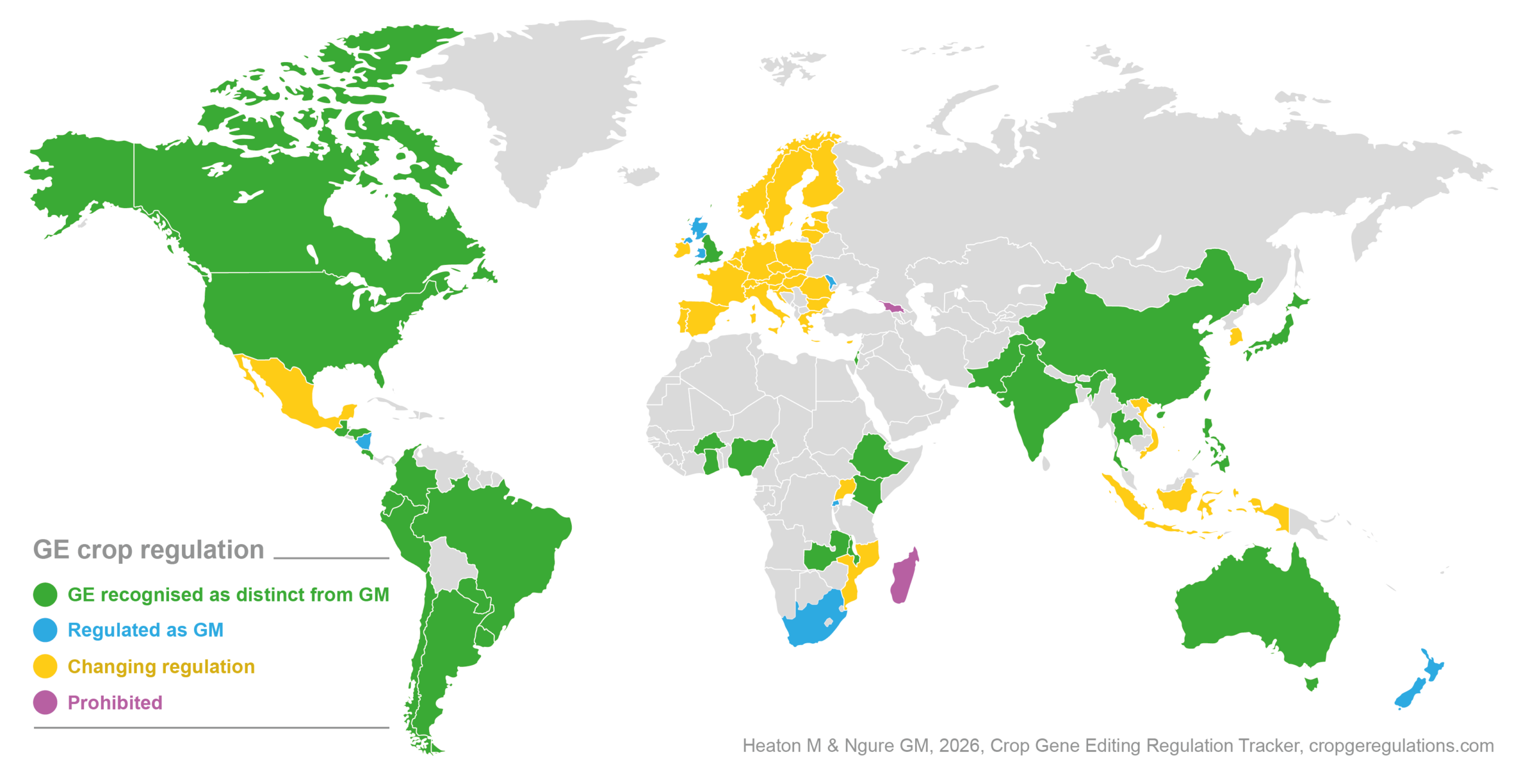
South American countries have been early GEd adopters, with Argentina enacting the first dedicated regulatory criteria for gene editing in 2015 (Argentina Resolution 173/2015). This created a system to define transgene-free plants that do not fall within the existing GMO framework. In 2026, based on the experience gained Argentina updated its framework (Resolution 24/2026). Chile followed in 2017 by adopting a case‑by‑case consultation process for GEd products, and exempted those that do not involve the insertion of foreign genes or create new combinations of genetic material, the following Chile’s Servicio Agrícola y Ganadero’s (SAG) Resolution No. 1523/200. As of January 2026, SAG is formalising this approach, with a draft available for public consultation. Also, in 2017 the Ministries of Agriculture from Argentina, Brazil, Chile, Paraguay, and Uruguay signed a declaration on new breeding techniques aiming to harmonise approval across the region. The following year, Brazil’s National Biosafety Technical Commission (CTNBio) released the Normative Resolution No. 16 (RN16), applying a case-by-case system and clarifying that many GEd products fall outside GM definitions. The same year, Colombia’s agricultural authority (ICA) issued Resolution 29299/2018 for a procedure to confirm if GEd products qualify as GM or conventional, which Colombia then updated in 2022 (Resolution 22991/2022). In 2019, both Paraguay (2019, National Commission on Agricultural and Forestry Biosafety, Resolution No. 842/2019) and Ecuador (Ministerial Agreement No. 063/2023) exempted transgene-free products from GM regulation. Uruguay remains more tentative, releasing the Gene Editing Decree in 2024, setting forth a gene editing approval process with a technical working group to determine whether a product should be considered a GM and subject to GM regulations (Gene Editing Decree 2024). Peru’s Ministry of the Environment (MINAM) approved guidelines in March 2026 to determine the status of Living Modified Organisms (LMOs/OVMs) developed through New Breeding Techniques (NBT), treating transgene-free products as conventionally bred (Law 29811 and its extension, Law 31111).
Central American changes have been more uneven. In 2019 El Salvador, Guatemala and Honduras began efforts to agree to a shared biosafety technical regulation to treat transgene-free GEd products as conventionally bred (inter-ministerial agreement RT 65:06.01:18). The regulation was harmonised between Honduras and Guatemala in 2019, and El Salvador adopted the same regulation only at the end of 2022. Also in 2019, Guatemala published Acuerdo Ministerial No. 271 to simplify the process for evaluation and registration of seeds, and exempt plants free of transgenes or a new combination of DNA. Also in 2019, Honduras’ National Service of Agricultural Health and Food Safety (SENASA) approved a simplified procedure to evaluate GEd products to determine the GMO status of GE’d crops within 45 days of an application. In 2023, Costa Rica updated its biotechnology regulatory framework to reduce barriers to use of GEd products. The Costa Rica government published Executive Decree 44020-MAG modifying articles 111 to 116 of Regulation 26921 (Implementing Regulations of the Phytosanitary Protection Law) and the State Phytosanitary Service published a reform to the biosafety framework establishing procedures to define whether GEd crops should be included as living modified organisms under the Phytosanitary Protection Law No. 7664.
North American regulators have adopted a dual approach, under which Canada and the United States assess precision‑bred crops as they would conventionally bred crops. In Canada, the regulatory trigger has historically regulated on the novelty of the trait, rather than the process, and that precision-bred GEd products are not counted as novel just because they are GEd (Canada’s Novel Food Regulations 1999, Guideline Update 2022.). In the US, regulation is split across Animal & Plant Health Inspection Service, Environmental Protection Agency and Food and Drug Administration. As the regulatory triggers are based on concepts predating the GMO era the USA has been able to provide clarifications that allow to treat similar products created by conventional or novel techniques in the same manner. In 2020, the US Department of Agriculture introduced the SECURE Rule – its first major revision of biotechnology regulations since 1987 – which updated 7 CFR part 340 to focus on product‑based plant‑pest risk and to exempt gene‑edited plants where the genetic change could have been achieved through conventional breeding. The rule was fully implemented in 2021, with APHIS issuing additional guidance to clarify developer pathways. SECURE was however prospectively vacated in 2024 by a court case against the USDA by anti-GMO activist groups including the Center for Food Safety. This decision had the legal effect of restoring the pre-May 2020 regulation, with the USDA restarting the biotechnology permitting and “Am I Regulated? inquiry processes in 2025 (interim rulemaking pending RIN 0579-AE84). While under this ruling GM products are more restricted than under SECURE, GEd products with foreign DNA are in the informal regulatory gap (likely unregulated), and developers can use the “Am I Regulated?” process to obtain written confirmation. In contrast to Canada and the US, Mexico continues to treat GEd products as GM under the 2005 Biosafety Law (Ley de Bioseguridad de Organismos Genéticamente Modificados, or LBOGM).
In the EU, discussions on New Breeding Techniques (NBTs) began in 2007, but the 2018 CJEU ruling served as the definitive catalyst for reform. The ruling clarified that, unlike the Cartagena Protocol, any plant created via a technical step is a GMO, exempting only plants created using those techniques with safety records established before 2001 from GMO requirements. Prompted by Member States to reassess this proportionality, the European Commission introduced the 2023 New Genomic Techniques (NGT) proposal, which distinguishes between Category 1 plants (conventional-like requiring a verification if meeting set criteria and transparency measure) and Category 2 plants (more complex modifications or captured by the sustainability criterion requiring adapted GMO requirements). It is envisaged that the NGT regulation will be adopted and published in summer of 2026 after which a two year implementation phase will allow the further development of the full NGT framework.
Post‑Brexit, the UK diverged through a two‑step reform, first easing field‑trial requirements for gene‑edited plants in 2022, followed by the Genetic Technology (Precision Breeding) Act 2023, which applies in England. The Act establishes a new category of Precision Bred Organisms (PBOs) for genetic changes that could have occurred naturally, enabling a streamlined route to market outside GMO regulations. In 2025, the Genetic Technology (Precision Breeding) Regulations 2025 were passed and came into force in November 2025, fully operationalising the framework for precision-bred plants. Northern Ireland, Scotland and Wales retain the EU alignment of using the EU GMO directive, although the UK Internal Market Act 2020 (UKIMA) means that England-grown PBOs must be sold as conventional crops across Scotland and Wales. However the UKIMA only allows sales across developed borders. Downstream further processing of PBOs would fall under Scottish or Welsh GMO rules, and currently subject to GMO regulation.
Elsewhere in Europe, Norway updated its Gene Technology Act last year to maintain case-by-case testing of all GM and GEd products, while also aligning with the EU’s future direction. However, if the EU redefines GMOs to exclude products of new genomic techniques (NGTs) from GM requirements, Norway must align due to its membership in the European Economic Area (EEA). Georgia adopted a ban in 2017 on gene-edited plants for cultivation, import, and export, making it one of two countries globally.
Middle Eastern countries have been slower to release GEd specific regulation. Israel’s National Committee for Transgenic Plants (NCTP) announced in 2017 and clarified in 2019 that transgene-free plants are exempt from GEd regulation on a case-by-case basis. Saudi Arabia allows the importation of biotech plant products, but they are required to be labelled if they contain more than one percent GM plant ingredients.
Seven countries from Africa (Kenya, Nigeria, Ghana, Malawi, Burkina Faso, Ethiopia and Zambia) have developed regulations to govern research and trade in GEd products. The regulatory considerations focus on combinations of the following criteria: (i) the presence of foreign gene elements from compatible or non-compatible species; (ii) presence or absence of markers in the final product; (iii) usage of a GM phase in the process of development and; (iv) types of edits being performed either SDN-1, SDN-2 or SDN-3. Subjecting or exempting a submitted dossier to or from the GM or conventional regulatory pathway is done on a case-by-case basis to determine the most feasible approach to arrive at a regulatory decision. Regulatory texts across the seven countries vary. Kenya updated its guidelines in 2025 to focus more on novelty and include epigenome edits, Nigerian text does not explicitly mention SDN type or epigenome edits, while Malawi, Burkina Faso and Ethiopia have not designated standard timelines for making decisions on genome editing dossiers. Burkina Faso requires that genome edits should produce phenotypes or traits that exist naturally in other types of organisms. Despite allowing commercial GM plant cultivation, South Africa still regulates GEd products using the GM framework. Discussions for updating GEd regulations have also started in Mozambique, Namibia, Rwanda, Swaziland, Tanzania, Uganda and Egypt.
Countries across Asia have seen a range of GEd regulatory recognition over the last five years. Japan finalised a policy in 2020 for a notification system by which certain transgene-free plants can proceed without full pre-market GMO-style safety review. This resulted in one of the first market released GEd crops, the high-GABA tomato. China’s Ministry of Agriculture and Rural Affairs released the 2022 Guidelines for Safety Evaluation of Gene-Edited Plants for Agricultural Use which did not exempt GEd products from GM but did establish a streamlined risk-based approval process for plants without exogenous DNA to reduce the trailing time. Detailed data requirements followed in 2024 with biosafety certificates announced that include GEd crops which is in line with the 2021 Biosecurity Law which included the goal of increasing China’s cultivation of GM and GEd crops. In 2022, India exempted SDN-1 and SDN-2 plants from the previous 1989 Environmental Protection Act, adding guidelines for evidence safety assessment and case-by-case release of GEd plants. The Philippines established in 2022 procedures determine whether GEd products are considered GM (JDC No. 01 s.2021 operationalised by DA Memorandum Circular No. 8). In 2023, UK‑based Tropic’s reduced‑browning gene‑edited banana became the first product to be confirmed as non‑GM under this system and offered to growers in March 2025 (Tropic, 2023). In 2023, Bangladesh developed standard operating procedures for research and release of SDN-1 and SDN-2 plants, similar to that of India. In 2024, Thailand, the Ministry of Agriculture and Cooperatives published regulations establishing certifications for transgene-free GEd crops on the grounds that these technologies are safe for humans and unlock higher value crops (Notification on Certification of Organisms Developed from Genome Editing Technology for Agricultural Use, B.E. 2567). The Singapore Food Agency implemented the “Regulatory Framework for the use of Genome Edited Crops for Food and Animal Feed” for transgene-free crops in 2024 with no labelling requirement. As of 2025 Indonesia has released regulation (BPOM Regulation No. 19/2024) establishes a case-by-case classification process whereby genome-edited food products are assessed by the National Biosafety Commission (BCGEP) and determined to be either GEd food (requiring full safety approval) or non-GEd food (treated as conventional). In 2026, Vietnam issued Decree 43/2026/ND-CP which distinguishes gene-edited organisms without foreign DNA from traditional GMOs under the amended Law on Biodiversity (Law 146/2025/QH15). South Korea drafted a 2024 bill with a category for transgene-free plants, although this has not yet been brought into effect. In 2026, Pakistan’s Federal Cabinet approved the country’s first-ever National Agriculture Biotechnology Policy, with SDN-1 and SDN-2 products not regulated as GMO. The secondary legislation to implement these changes is currently under discussion.
In Australasia, New Zealand’s EPA ruled in 2014 that organisms produced using GEd would be classified as GM under the Hazardous Substances and New Organisms (HSNO) Act. This was narrowed in 2016 to only apply to techniques not in use before 1998. In 2024, New Zealand introduced the Gene Technology Bill, which discussed exempting low-risk edits that mimic conventional breeding outcomes, signalling a potential shift from a process to an outcome-based definition. Australia in 2019 updated the Gene Technology Regulations so that organisms using SDN-1 are not regulated as GM. Changes that involve the use of a repair template, however, remain within the GM framework. In 2025 the joint Food Standards Australia New Zealand (FANZ) agency updated the ‘novel DNA’ and ‘novel food’ definitions to allow use of an outcome-based evaluation. Transgene-free crops do not classify as GM food under this new ruling.
A general shift across countries adopting GEd regulations is to move from a process-based regulation to a case-by-case product approach mainly based on presence/absence of foreign DNA in the subject of evaluation, thereby reducing regulatory requirement for GEd products and differentiating their regulatory pathway from that of GMOs. Consequently, crop research and breeding have been encouraged to use these technologies as viable pathways to market. Early adopter frameworks have also offered examples for other countries considering updating their definitions and regulations for GEd. However, many countries are still yet to distinguish GEd and specifically regulate GEd products differently. This variation presents the potential for trade impacts(Hundleby & Harwood, 2022). Some of these changes have also brought pushback from groups operating in the political or public perception circles. Some groups support harmonisation efforts, such as the African Union, the Common Market for Eastern and Southern Africa (COMESA) and East African Community (EAC), the Economic Community of West African States (ECOWAS) and the International Service for the Acquisition of Agri-biotech Applications (ISAAA). These considerations bring us to the emerging future for global GEd regulation.
Emerging future
GEd regulations are at a time of focus and change. In this section, we consider areas where we are likely to see developments soon.
Recently, African Heads of State launched the Comprehensive African Agriculture Development (CAADP) strategy and action plan for 2026-2035 which replaces the post-Malabo era. The focus of the new strategy is on building resilient agri-food systems. The strategy recognizes Biotechnology among other innovations as critical for enhancing productivity. The African Continental Free Trade Area (AfCFTA) Initiative which seeks to boost intra-African trade is also expected to trigger harmonization of policies, regulations and standards through removal of tariffs and non-tariff barriers to create systems that are less susceptible to external shocks. This is crucial for enhancing access to markets, stabilization of prices and for building resilient agri-food systems. With these developments, we expect that during this period several countries will domesticate the Cartagena Protocol on Biosafety (CPB) commitments through enactment of national level biosafety legislation and attendant GEd guidelines to govern research, trade access and by doing so support realization of Agenda 2063 aspirations.
In addition to regulation, commercialisation is essential realising the benefits of GEd innovations. Many crop GEd innovations use the Cas9 approach. While using Cas9 for research requires no licensing cost, costs are required at the commercialisation stage, maintenance and royalties stages. The costs associated with licensing, and freedom to operate remain unclear for many and impact what crops and traits are commercially viable. The actual prices for these stages are negotiated and range in magnitude, where the negotiations might be something that certain players have no experience with. Some institutes have however agreed arrangements for use of Cas9 technology. Such an example could provide a model for other institutes or organisations. Alternatively, researchers are looking into use of other approaches, such as Cas12, to achieve gene editing changes through an alternative patenting landscape.
Recommendations
GEd holds great potential as a tool to address global challenges in food production, nutrition, climate resilience and rural livelihoods. Realising these benefits requires regulatory systems that are scientifically grounded, proportionate to risk and practical to implement. Based on the historic, current and prospective patterns across GEd global regulation, we propose the following recommendations.
1. Adopt product‑based rather than process‑based regulation
GEd techniques offer a wide range of potential product outputs, from a single SNP to complex multi‑gene modifications with many edits indistinguishable from those achievable through conventional breeding. Given the range of outputs from GEd biotechnology, it makes sense to have bespoke regulation at a product level. Equally, it makes little sense to regulate transgene-free GEd products on rulings designed to test and control the effect and movement of transgenes. Regulatory oversight should therefore focus on the characteristics of the final product, not the method used to create it. Adopting a product-based regulatory system provides appropriate testing and greater clarity in exchange of material. Product‑based regulation improves scientific alignment, supports proportionality and provides clearer pathways for innovation.
2. Align regulation of transgene-free GEd products with conventional pathways
Where GEd products are genetically indistinguishable from those derived from conventional breeding, they should follow regulatory pathways aligned with conventional practices. Regulations attempting to restrict access or movement of transgene-free GEd products are not proportionate and will struggle in delivery and enforcement. Product-based regulation of GEd provides clear regulation of these technologies and enables product-focused research and development planning.
Treating transgene-free GEd products as conventional is science-based and enables researchers to make targeted changes and bring innovations to users faster and at lower cost than GM regulatory pathways. Without this, researchers will choose slower and more imprecise conventional methods for their lower regulatory costs. Put another way, researchers will be forced to pursue the easier regulatory route, rather than the best product pathway for users. Regulating transgene-free GEd products as conventional therefore empowers researchers to choose the best technology for the task, and raises the likelihood of users gaining better products in less time.
3. International alignment
Transnational acceptance of our recommendations also brings in the opportunity for greater exchange of GEd technologies. These time and exchange components are important given the pressing food security challenges crops breeding tries to address. Divergent regulatory systems for GEd products complicate research collaboration, seed movement and agricultural trade. Greater transparency, dialogue and coordination between countries, such as shared criteria, aligned definitions and interoperable regulatory frameworks would reduce trade friction and support global food security.
International trade of GEd products depends on alignment and harmony in regulation, which requires dialogue, coordination, mutual acceptance systems and advocacy amongst researchers, regulators and policymakers, with farmers and affected stakeholders. It calls for mutual policy learning engagements, in sharing frameworks and standard operating procedures for research, development and field trials. Close international working would also provide clarity for global trade partnerships for streamlined movement of crop products and support the 2018 joint statement to the WTO urging members to avoid trade barriers.
In the face of the potential for regulatory asynchrony and inconsistency, national policies should also be implemented to enable and facilitate domestic market access, regardless of foreign barriers. Non-tariff trade barriers should not inhibit the ability of governments and stakeholders to secure the benefits of GEd products within their borders.
4. Regulatory performance metrics
There is potential value in metrics that indicate effective GEd regulatory practice to guide ongoing learning and improvement of systems. Regulatory change to permit GEd release does not necessarily result in increased release of GEd products. Different regulatory processes might constrain or enable release to different extents. There is therefore not only a need to consider policy recognition of GEd products as distinct from GM, but also to recognise which regulators systems are performing best to enable the release of new products. Some of this might also be found in the changes made when countries update previous regulations based on their performance in practice. Such data can highlight where particular processes are more effective at enabling research outputs and these findings should be shared as case studies as with regulatory actors internationally. An emerging theme here is that building flexibility in and scaling of regulatory systems can support greater development of products. Ideas for performance indicators could include:
- Input indicators: number of consultations / notifications / applications; time-to-decision; compliance costs; number of trials.
- Outcomes: number of individual and batch GEd products approved; crop / trait diversity; participation by SMEs / public sector. Details of crops / traits targeted and whose priorities these benefit.
5. Communication, transparency and public engagement
We also advocate for greater communication around GEd crops and their regulation. Societal acceptance of GEd and its regulation depends upon effective communication among researchers, developers, regulators, policymakers and with the public, which can shape regulatory processes, consumer acceptance and product commercialisation. Limited awareness remains a major driver of public uncertainty in food innovation but scientific information alone however will not be sufficient to guide regulatory acceptance (Kunyanga et al., 2023).
Early GM communication showed the limitations of a deficit-model to drive acceptance (Marris, 2001). Consumer acceptance of GEd foods is shaped by the availability and credibility of information, awareness, regulatory frameworks, and understanding. However, public perception studies show citizens are more concerned with governance processes, accountability, transparency and benefit distribution (Muringai et al., 2020; Ortega et al., 2022; Spök et al., 2022; Shigi and Seo, 2023; Oh and Lee, 2025 Marris, 2001; Weldon and Laycock, 2009). Communications efforts seeking to improve understanding and advocacy for GEd acceptance must therefore do more than simply communicate the science.
The rise of digital communications and social media has transformed many aspects of our lives, including how GEd crops are viewed and contested (Brossard, 2013; Ji et al., 2022). These platforms have greater reach but the absence of traditional gatekeepers and the prevalence of algorithmic filtering have supported rapid circulation of misinformation on the risks of GEd crop technologies, influencing public trust (Scheufele and Krause, 2019). Historical GM crop debates show that institutional absence from these informal spaces permits external actors to dominate the discourse.
Lessons can be learned in the Kenyan approach to tackle misinformation where the ISAAA AfriCenter provided training to government and media on GEd technologies. This training helped media experts identify misinformation and ensure that news from trusted sources remained evidence-based. We encourage sharing of such communications strategies internationally. Researchers, institutions, and regulators must actively engage across digital media landscapes to ensure experts shape public awareness of the benefits and safety of GEd crop technologies (Menary and Fuller, 2024).
Conclusions
The evolution of GEd regulation reflects a wider story about how societies respond to new technologies: initial caution, uneven adaptation and persistent reliance on frameworks designed for older technologies. GM regulation was built around potential concerns about transgenes, and while it served an important purpose at the time, it also decreased market acceptance and created a regulatory architecture not fit for GEd. The result is a mix of process‑based and product‑based approaches and a global patchwork of rules that does not always align with the scientific distinctions.
For GEd to deliver meaningful public value, countries need regulatory systems that are scientifically grounded, proportionate to risk, and that are also feasible to implement. We must also bridge the gap between scientific discovery and real‑world deployment. A functioning innovation pathway requires that scientific advances are fairly assessed for translation, rather than prevented by prohibitive financial or legal uncertainties. Disproportionate regulatory requirements cause long timelines and approval uncertainties that raise the investment risk profile of GEd development, narrowing participation to well-resourced actors and limiting the diversity of crops and traits that can advance. Reducing these impediments would improve scope for a wider portfolio of crops and traits, such as crops that improve nutrition, climate adaptation, livelihood improvements and reduced environmental impact. Such outcomes require proportionate regulation, and funding mechanisms, incentives, and public-private partnerships that actively support the translation of research into accessible products. Doing so would support shifts to more resilient production systems, healthier diets and thriving livelihoods.
References
AgbioInvestor. (2022). Time and Cost to Develop a New GM Trait. https://croplife.org/wp-content/uploads/2022/05/AgbioInvestor-Trait-RD-Branded-Report-Final-20220512.pdf
Ampadu-Ameyaw, R., Essegbey, G. O., and Amaning, E. O. (2021). Public awareness, participation and attitude toward the national biosafety framework and genetically modified organisms in Ghana. Journal of Biosafety and Biosecurity 3, 147–153. doi: 10.1016/j.jobb.2021.10.003
Brookes, G. and Smyth, S.J. (2024) ‘Risk-appropriate regulations for gene-editing technologies’, GM Crops & Food, 15(1), pp. 1–14. Available at: https://doi.org/10.1080/21645698.2023.2293510.
Brossard, D. (2013). New media landscapes and the science information consumer. Proc. Natl. Acad. Sci. U.S.A. 110, 14096–14101. doi: 10.1073/pnas.1212744110
Court of Justice of the European Union (CJEU): Judgment of 25 July 2018, Confédération paysanne and Others, Case C-528/16, ECLI:EU:C:2018:583
Donnelly, C.A. et al. (2018) ‘Four principles to make evidence synthesis more useful for policy’, Nature, 558(7710), pp. 361–364. Available at: https://doi.org/10.1038/d41586-018-05414-4.
Entine, J. et al. (2021) ‘Regulatory approaches for genome edited agricultural plants in select countries and jurisdictions around the world’, Transgenic Research, 30(4), pp. 551–584. Available at: https://doi.org/10.1007/s11248-021-00257-8.
Evenson, R.E. and Gollin, D. (2003) ‘Assessing the Impact of the Green Revolution, 1960 to 2000’, Science, 300(5620), pp. 758–762. Available at: https://doi.org/10.1126/science.1078710.
FAO (2020) ‘Food Outlook – Biannual Report on Global Food Markets’, p. 107. Available at: https://doi.org/https://doi.org/10.4060/cb1993en.
FAO et al. (2020) The State of Food Security and Nutrition in the World 2020. Transforming food systems for affordable healthy diets. Available at: https://doi.org/10.4060/ca9692en.
Feng, Z., Zhang, B., Ding, W. et al. Efficient genome editing in plants using a CRISPR/Cas system. Cell Res 23, 1229–1232 (2013). https://doi.org/10.1038/cr.2013.114
Godfray, H.C.J. et al. (2010) ‘Food Security: The Challenge of Feeding 9 Billion People’, Science, 327(5967), pp. 812–818. Available at: https://doi.org/10.1126/science.1185383.
Hartung, F. and Schiemann, J. (2014) ‘Precise plant breeding using new genome editing techniques: opportunities, safety and regulation in the EU’, The Plant Journal, 78(5), pp. 742–752. Available at: https://doi.org/10.1111/tpj.12413.
Heaton M & Ngure GM, 2026, Crop Gene Editing Regulation Tracker Maps, cropgeregulations.com, Retrieved from: ‘https://cropgeregulations.com/maps/’ Online Resource. https://doi.org/10.5281/zenodo.20057755
Hundleby, P. and Harwood, W. (2022) ‘Regulatory Constraints and Differences of Genome-Edited Crops Around the Globe’, in S.H. Wani and G. Hensel (eds) Genome Editing: Current Technology Advances and Applications for Crop Improvement. Cham: Springer International Publishing, pp. 319–341. Available at: https://doi.org/10.1007/978-3-031-08072-2_17.
Ji, J., Robbins, M., Featherstone, J. D., Calabrese, C., and Barnett, G. A. (2022). Comparison of public discussions of gene editing on social media between the United States and China. PLoS ONE 17, e0267406. doi: 10.1371/journal.pone.0267406
Jinek, M., Chylinski, K., Fonfara, I., Hauer, M., Doudna, J.A. & Charpentier, E. (2012) ‘A Programmable Dual-RNA–Guided DNA Endonuclease in Adaptive Bacterial Immunity’, Science, 337(6096), pp. 816–821. Available at: https://doi.org/10.1126/science.1225829.
Kock, M.A. (2021) ‘Open Intellectual Property Models for Plant Innovations in the Context of New Breeding Technologies’, Agronomy, 11(6), p. 1218. Available at: https://doi.org/10.3390/agronomy11061218.
Komor, A.C. et al. (2016) ‘Programmable editing of a target base in genomic DNA without double-stranded DNA cleavage’, Nature, 533(7603), pp. 420–424. Available at: https://doi.org/10.1038/nature17946.
Kunyanga, C. N., Byskov, M. F., Hyams, K., Mburu, S., Werikhe, G., and Onyango, C. M. (2023). Perceptions of the Governance of the Technological Risks of Food Innovations for Addressing Food Security. Sustainability 15, 11503. doi: 10.3390/su151511503
Lassoued, R. et al. (2019) ‘Estimating the cost of regulating genome edited crops: expert judgment and overconfidence’, GM Crops & Food, 10(1), pp. 44–62. Available at: https://doi.org/10.1080/21645698.2019.1612689.
Lowe, N.M. (2021) ‘The global challenge of hidden hunger: perspectives from the field’, Proceedings of the Nutrition Society, 80(3), pp. 283–289. Available at: https://doi.org/10.1017/S0029665121000902.
Lukasiewicz, J.M. et al. (2024) ‘Intellectual property rights and plants made by new genomic techniques: Access to technology and gene-edited traits in plant breeding’, Outlook on Agriculture, 53(3), pp. 205–215. Available at: https://doi.org/10.1177/00307270241277219.
Macnaghten, P., and Habets, M. G. J. L. (2020). Breaking the impasse: Towards a forward‐looking governance framework for gene editing with plants. Plants People Planet 2, 353–365. doi: 10.1002/ppp3.10107
Marris, C. (2001). Public views on GMOs: deconstructing the myths: Stakeholders in the GMO debate often describe public opinion as irrational. But do they really understand the public? EMBO Reports 2, 545–548. doi: 10.1093/embo-reports/kve142
Menary, J., and Fuller, S. S. (2024). New genomic techniques, old divides: Stakeholder attitudes towards new biotechnology regulation in the EU and UK. PLoS ONE 19, e0287276. doi: 10.1371/journal.pone.0287276
Mewett, O. et al. (2026) ‘Re-evaluating the site-directed nuclease classification as a regulatory trigger for genome-edited plant products’, Nature Biotechnology, pp. 1–4. Available at: https://doi.org/10.1038/s41587-026-03028-0.
Muringai, V., Fan, X., and Goddard, E. (2020). Canadian consumer acceptance of gene‐edited versus genetically modified potatoes: A choice experiment approach. Canadian J Agri Economics 68, 47–63. doi: 10.1111/cjag.12221
Nawaz, S. and Satterfield, T. (2022) ‘On the nature of naturalness? Theorizing “nature” for the study of public perceptions of novel genomic technologies in agriculture and conservation’, Environmental Science & Policy, 136, pp. 291–303. Available at: https://doi.org/10.1016/j.envsci.2022.06.008.
OECD (1986), Recombinant DNA Safety Considerations: Safety Considerations for Industrial, Agricultural and Environmental Applications of Organisms derived by Recombinant DNA Techniques, OECD Publishing, Paris
Office of Science and Technology Policy (OSTP). 1986. “Coordinated Framework for Regulation of Biotechnology.” Federal Register 51(123):23302.
Oh, S.-D., and Lee, B. (2025). Analysis of the public perception and acceptance of gene-editing technology and gene-edited agricultural products in South Korea. GM Crops & Food 16, 795–810. doi: 10.1080/21645698.2025.2576272
Organisms (GMO), E.P. on G.M. (2012) ‘Scientific opinion addressing the safety assessment of plants developed using Zinc Finger Nuclease 3 and other Site-Directed Nucleases with similar function’, EFSA Journal, 10(10), p. 2943. Available at: https://doi.org/10.2903/j.efsa.2012.2943.
Ortega, D. L., Lin, W., and Ward, P. S. (2022). Consumer acceptance of gene-edited food products in China. Food Quality and Preference 95, 104374. doi: 10.1016/j.foodqual.2021.104374
Podevin, N. et al. (2012) ‘Transgenic or not? No simple answer!’, The EMBO Reports, 13(12), pp. 1057–1061. Available at: https://doi.org/10.1038/embor.2012.168.
Podevin, N. et al. (2013) ‘Site-directed nucleases: a paradigm shift in predictable, knowledge-based plant breeding’, Trends in Biotechnology, 31(6), pp. 375–383. Available at: https://doi.org/10.1016/j.tibtech.2013.03.004.
Puchta, H., Dujon, B. and Hohn, B. (1993) ‘Homologous recombination in plant cells is enhanced by in vivo induction of double strand breaks into DNA by a site-specific endonuclease’, Nucleic Acids Research, 21(22), pp. 5034–5040. Available at: https://doi.org/10.1093/nar/21.22.5034.
Qiao, J. et al. (2022) ‘Global burden of non-communicable diseases attributable to dietary risks in 1990–2019’, Journal of Human Nutrition and Dietetics, 35(1), pp. 202–213. Available at: https://doi.org/10.1111/jhn.12904.
Ricroch, A. et al. (2026) ‘Global status of genome editing versus transgenesis legislation in plants and the current EU situation’, npj Science of Plants, 2(1), p. 3. Available at: https://doi.org/10.1038/s44383-025-00016-2.
Scheufele, D. A., and Krause, N. M. (2019). Science audiences, misinformation, and fake news. Proc. Natl. Acad. Sci. U.S.A. 116, 7662–7669. doi: 10.1073/pnas.1805871115
Secretariat of the Convention on Biological Diversity (2000). Cartagena Protocol on Biosafety to the Convention on Biological Diversity: text and annexes. Montreal: Secretariat of the Convention on Biological Diversity.
Shigi, R., and Seo, Y. (2023). Consumer Acceptance of Genome-Edited Foods in Japan. Sustainability 15, 9662. doi: 10.3390/su15129662
Spök, A., Sprink, T., Allan, A. C., Yamaguchi, T., and Dayé, C. (2022). Towards social acceptability of genome-edited plants in industrialised countries? Emerging evidence from Europe, United States, Canada, Australia, New Zealand, and Japan. Front. Genome Ed. 4, 899331. doi: 10.3389/fgeed.2022.899331
Sprink, T. et al. (2016) ‘Regulatory hurdles for genome editing: process- vs. product-based approaches in different regulatory contexts’, Plant Cell Reports, 35(7), pp. 1493–1506. Available at: https://doi.org/10.1007/s00299-016-1990-2.
Stoll-Kleemann, S. and O’Riordan, T. (2015) ‘The Sustainability Challenges of Our Meat and Dairy Diets’, Environment: Science and Policy for Sustainable Development, 57(3), pp. 34–48. Available at: https://doi.org/10.1080/00139157.2015.1025644.
Sundaram, L.S., Ajioka, J.W. and Molloy, J.C. (2023) ‘Synthetic biology regulation in Europe: containment, release and beyond’, Synthetic Biology, 8(1), p. ysad009. Available at: https://doi.org/10.1093/synbio/ysad009.
Tropic (2023). Tropic’s Non‑Browning Gene‑Edited Banana Cleared for Production in the Philippines. Published April 17, 2023.
Van Der Meer P, Angenon G, Bergmans H, et al. The Status under EU Law of Organisms Developed through Novel Genomic Techniques. European Journal of Risk Regulation. 2023;14(1):93-112. doi:10.1017/err.2020.105
Van Eck, J., 2020. Applying gene editing to tailor precise genetic modifications in plants. Journal of Biological Chemistry, 295(38), pp.13267-13276.
Vengadesen, S., Bin Abdul Aziz, M.F. and Jones, MichaelG.K. (2025) ‘Rethinking gene-edited crop regulation: advancing a Principle-based framework for modern biotechnology governance’, GM Crops & Food, 16(1), pp. 852–869. Available at: https://doi.org/10.1080/21645698.2025.2576734.
Weldon, S., and Laycock, D. (2009). Public opinion and biotechnological innovation. Policy and Society 28, 315–325. doi: 10.1016/j.polsoc.2009.09.005
Whelan, A.I. and Lema, M.A. (2015) ‘Regulatory framework for gene editing and other new breeding techniques (NBTs) in Argentina’, GM Crops & Food, 6(4), pp. 253–265. Available at: https://doi.org/10.1080/21645698.2015.1114698.
Yamaguchi, T., Ezaki, K. and Ito, K. (2024) ‘Exploring the landscape of public attitudes towards gene-edited foods in Japan’, Breeding Science, 74(1), pp. 11–21. Available at: https://doi.org/10.1270/jsbbs.23047.
Yang, Z., Jiang, Y., Feng, Y., and Wang, G. (2025). How labeling of genetically modified foods affects consumers’ purchase intentions: a multi-contextual analysis. GM Crops & Food 16, 688–708. doi: 10.1080/21645698.2025.2572191
Zhang, F. et al. (2010) ‘High frequency targeted mutagenesis in Arabidopsis thaliana using zinc finger nucleases’, Proceedings of the National Academy of Sciences, 107(26), pp. 12028–12033. Available at: https://doi.org/10.1073/pnas.0914991107.
Zimny, T. et al. (2019) ‘Certain new plant breeding techniques and their marketability in the context of EU GMO legislation – recent developments’, New Biotechnology, 51, pp. 49–56. Available at: https://doi.org/10.1016/j.nbt.2019.02.003.
Share this article