Socio-economic insights for Kenyan wheat improvement: Lessons from the field
NISD Internship Student, Deima Daujotaite spent six weeks over 2025 in Njoro, Kenya on field research, working with local communities to understand needs and opportunities for wheat improvement. In this post, Deima shares her experience of our time in the field and what this research can show us.
Being an undergraduate global development student at UEA comes with many travel opportunities, both within the country as well as overseas. As part of my course, one particular module gave me the opportunity to seek work experience within organisations, my choice of which being the NISD.
As part of my internship I travelled to Kenya, working within the Kenyan Agricultural and Livestock Research Organisation (KALRO), in Njoro. This specific KALRO centre was built due to its location being a ‘hotspot’ for wheat rusts, perfect for research and testing for resistant varieties. It was only later on that the centre widened their field of research to include other crops, such as canola, castor and cassava.
My work was specifically centred around the UK-CGIAR wheat project, focusing on developing new rust-resistant and iron-nutritious wheat varieties. During my 7 week stay, I worked closely with the socioeconomics team in collecting, transcribing, organising and analysing qualitative interview data on wheat farmers. By doing this, I learnt the importance of communication and the level of coordination needed to maintain organised data collection systems, that could then be efficiently analysed to identify reoccurring themes or interest.
While spending most of my time transcribing interviews and organising files, I had a number of highlight moments during my placement trip, one of these being the Nakuru national agricultural show. I was able to engage in stimulating conversations with many key players in the agricultural sector of Kenya, such as KEPHIS, Kenya Seed and NCPB. Being able to discuss critical topics surrounding worries and opportunities within agriculture in Kenya inspired many of my later reflections within the project work.
At this show, KALRO was ranked 1st for the ‘best agricultural based statutory board stand’, and ‘the best stand in (non-education) research and development’. Despite my main focus being on wheat, I partook in enriching conversations about the many benefits of other crops within the centre, such as castor. Such conversations at the national show fuelled my desire to carry on studying within the agricultural sector.
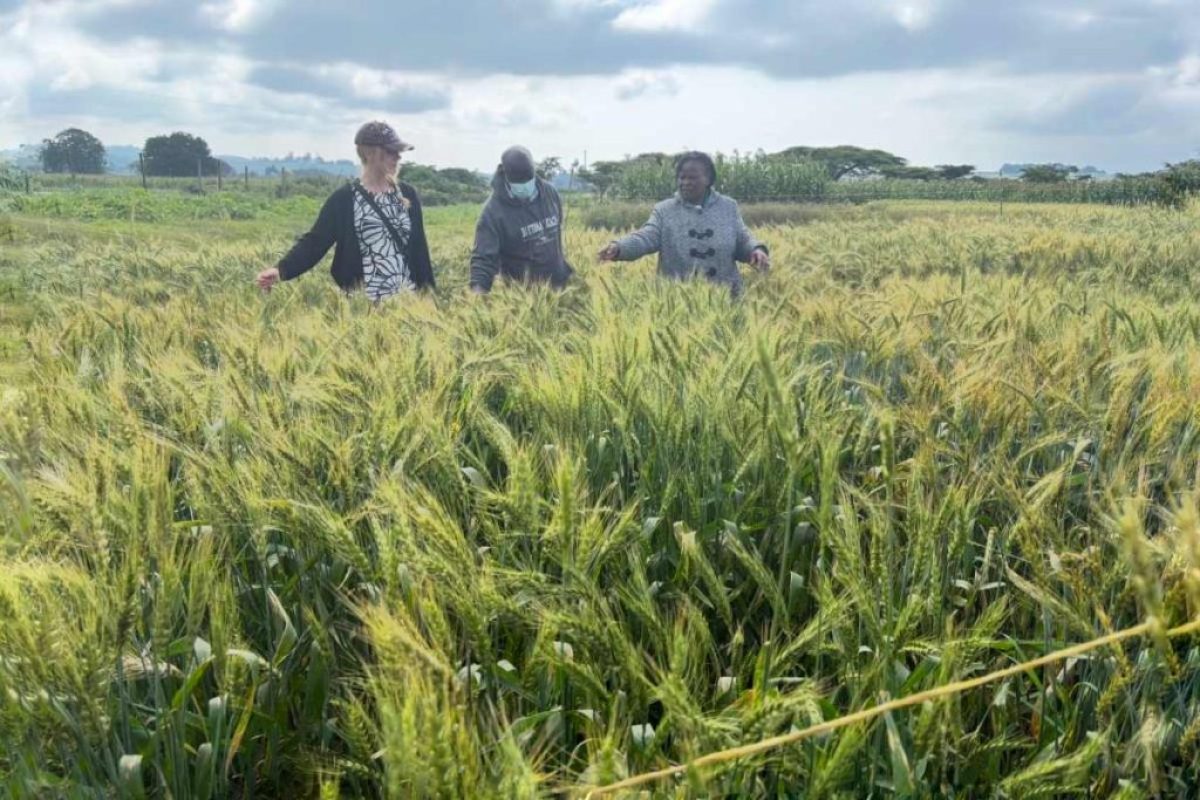
The main highlight of my trip however was the fieldwork in Narok. I was lucky enough to receive a chance to assist in collecting interview data from Narok farmers, alongside the socioeconomics team. This included a 5-day excursion, locating and interviewing local farmers with pre-made questionnaires on the challenges people face in wheat production. The weeks activities included a lot of travel to contact town heads or ‘village elders’, who were then able to steer us in the direction of farmers. In many cases, interviews were done in random locations, such as markets, shops, and even outside on the paths. While proving difficult at times, this excursion was a success, with over 40 interviews collected.
I myself had the opportunity to take part in the interview process, developing skills of conducting semi-structured interviews accordingly, while still keeping the farmer engaged. My fascination came from the answers being given by many farmers, and the way these answers correlated across the span of interviews in the week. While many questions had similar responses, some farmers produced interesting outputs based on their personal experiences in wheat farming.
I believe such personal experiences are crucial to capture in social research, especially when aiming to introduce a new product for a group that feels underrepresented in their field. Many wheat farmers implied that they no longer want to produce wheat, due to the lack of market or care given to them from larger corporations. By identifying these issues, we are already emphasising the importance of training and showcasing new products and minimising the issues that may come from lack of exposure. With this process, we are also able to identify many small and large-scale farmers across Narok and other regions, who will then be informed of any new changes in the wheat production process.
Coming back from the field left me with many reflections, not only from the interviews but also observations in the local areas we visited. Having the chance to share these reflections with the team encouraged engaging conversations that led to useful conclusions, which will later be used to accompany the interview data analysis.
Once the interview data was transcribed and compiled, I took the opportunity to teach myself the basics on utilising NVIVO. This software allowed us to efficiently code the data, and filter it to show comparisons between different participant attributes, as well as cross referencing between different themes. I went on to teach the skills I acquired to the socioeconomics team in a two-day intensive, and by the end we were all able to efficiently code and identify patterns within data. In addition to this, I created useful ‘Qualitative data helpsheets’ to provide the team with, explaining the basics and importance of conducting social research correctly, specifically providing tools to help with this project.
Overall, my experience in Kenya was one I will remember forever. The skills I learnt provided me with the perfect start to my future career, which I hope to carry on developing over time. Doing an international placement was the best decision I have made not only in the academic aspect, but also in life.
Authors

Deimantė Daujotaite
Share this article
Follow us