Julie Bremner
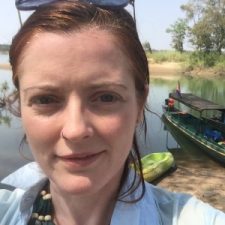
NISD Member
CEFAS, UEA
Bio
Julie is a Principal Marine Ecologist at the Centre for Environment, Fisheries and
Aquaculture Science (Cefas) and an honorary associate professor in
the UEA
School of Environmental Sciences. She has a background in marine benthic
ecology and ecosystem function.
Julie’s research explores the effects humans can have on
marine biodiversity and ecosystems and how we can pursue sustainable management
of the seas’ resources. Working with other natural scientists, social
scientists, governments and industry, her research focusses on the
environmental pillar of sustainability, considering the impacts of, and
opportunities for, marine food production, marine energy and climate change.
Julie has broad interests and is fundamentally intrigued by how things connect
– across environments, across human activities and across environmental and
cultural priorities.
Julie is the Cefas topic lead for Coastal Ecosystems and for
Aquatic Food Systems and is the Biodiversity and Ecosystems science lead at the
Cefas/UEA Collaborative
Centre for Sustainable Use of the Seas (CCSUS).
Current projects
Co-PI, UK Government funded ‘One Food’ project, using the
One Health approach to develop a toolbox for managing food safety, health, climate
and environmental hazards across entire food systems with a view to providing
net benefits for biodiversity and climate.
Science Lead, EU Horizon funded ‘Marine Biodiversity and
Ecosystem Function Leading to Ecosystem Services (MARBEFES)’, a 24-partner project
researching patterns of biodiversity and its ecological, social and economic
value.
Co-investigator, EU Horzon funded ‘Marine Systems Approaches
for Biodiversity Resilience and Ecosystem Sustainability (Marine SABRES); a
21-partner project co-developing and testing a simple socio-ecological system.
Investigator, UK Government funded ‘Ocean Country
Partnership Programme’ for international scientific capacity development in
marine resource management. Solomon Islands seafood activities.
Co-investigator, UKRI ‘The ARISE Initiative’, which seeks to
develop resilience within the UK’s coastal seas and communities.
Recent publications
Gill, A.B., Bremner, J., Vanstaen, K., Blake, S., Mynott,
S., Lincoln, S. (2025) Limited evidence base for determining impacts (or not)
of offshore wind energy development on commercial fisheries. Fish and Fisheries
26 (1) 155-170
Willer, D.F., Short, S., Khripko, D., Petrovan, S.O.,
Christie, A.Pl, Bremner, J., Sutherland, W.J., Aldridge, D.C. (2025) Mapping
hazards to the global food system. Environ Monit Assess 197,
18. https://doi-org.uea.idm.oclc.org/10.1007/s10661-024-13475-4
Rao, N., Hooper, L., Gray, H., Grist, N., Forster, J.,
Bremner, J., Sabir, G., Heaton, M., Marwaha, N., Sudarshan, T., Wanyama, A., Zhang,
L. (2024) A systematic review of the impact of post-harvest aquatic food
processing technology on gender equality and social justice. Nat Food 5.
731–741. https://doi-org.uea.idm.oclc.org/10.1038/s43016-024-01034-6
Tsikopolou, I., Nasi, F., Bremner, J. (2024) The importance
of understanding benthic ecosystem functioning. Frontiers in Marine Science 11.
https://doi.org/10.3389/fmars.2024.1470915
Bremner, J., Vial, F., Fooks, A., Higman, W., Avant, J., Stentiford, G. (2023) Operationalising ‘One Health’ for food systems. One Earth, 6 (12), P1618-1622